Learn more about youth vaping and vaping-related health risks in this episode of Let’s Talk Lungs, featuring expert insights from respirologist Dr. Erika Penz for parents, educators and caregivers.

Let’s Build a Smoke-Free Generation
Protect kids from tobacco, vaping and nicotine products.
Canada continues to face high rates of youth vaping and nicotine use. A Smoke-Free Generation is a gradual, long-term approach that would ensure future generations cannot legally purchase commercial nicotine products, helping stop nicotine addiction before it starts.
Together, we can help create a future where the next generation never becomes addicted to nicotine.
0
%
of Canadians say it’s important to prevent children from ever taking up smoking or vaping.
0
%
support stronger rules to keep tobacco and vaping products out of the hands of youth.
0
%
support a Smoke-Free Generation law.
CANADIANS ARE READY TO HELP BUILD A
SMOKE-FREE
GENERATION.
Most nicotine addiction starts young.
Nicotine is a highly addictive drug. The younger someone starts using nicotine, the greater the risk of lifelong addiction.
Canada's youth are facing a growing nicotine crisis.
Canada has among the highest youth vaping rates in the world.
12% of high school students are vaping daily
Nicotine is a highly addictive drug that poses unique dangers to youth.
Nicotine can:
Harm brain development
Affect attention, learning, memory, and mood
Increase the risk of future addiction to other drugs
Negatively affect mental health and well-being
WHAT IS A SMOKE-FREE GENERATION
A simple idea designed to prevent future generations from becoming addicted to tobacco by gradually raising the legal age at which tobacco products can be sold.
HOW IT WORKS:

Current Adults
No change. Adults who can legally purchase nicotine products today would continue to do so.

Born in 2009 or Later
Would never become eligible to purchase commercial nicotine products.

A Smoke-Free Generation
Over time, fewer young people become addicted to nicotine, creating a healthier future for all Canadians.
Building a Smoke-Free Generation starts with understanding how the policy works. Explore the infographic below for a quick overview of the key facts and common misconceptions:
Smoke-Free Generation:
What It Is and What It Isn’t
A Smoke-Free Generation is a practical, evidence-informed approach to protecting future generations from nicotine addiction, before it starts.
- What it is
A plan to prevent youth nicotine addiction before it starts.
Future generations would never become eligible to purchase commercial nicotine products.
A gradual approach focused on future generations.
The policy phases in over time and does not affect current adults or anyone who is of legal age to purchase nicotine and tobacco products.
Protection from cigarettes, vape and other nicotine products.
The approach applies to more than just cigarettes.
A long-term strategy to improve public health.
Designed to reduce nicotine addiction and tobacco-related disease over time.
V
S
- What it isn't
Smoke-Free Generation does not ban nicotine products for adults who can legally purchase them today.
Adults who can legally purchase nicotine products today would continue to do so.
Smoke-Free Generation does not affect Indigenous sacred or ceremonial tobacco use.
Traditional tobacco used in First Nations ceremonial, spiritual, learning, and healing practices would not be affected.
Smoke-Free Generation does not require current users to quit
The policy does not force existing users to stop using nicotine products.
A Smoke-Free Generation policy is not a restriction on products already legally purchased by adults.
It does not affect adults or anyone of legal age who already purchase or use tobacco or nicotine products.
It is not a sudden prohibition affecting existing consumers.
Changes would occur gradually over decades, not overnight.
What products are included?
The policy would apply to commercial nicotine products, including:
- Cigarettes
- Cigars
- Vapes and e-cigarettes
- Smokeless nicotine products
- Future nicotine products not yet on the market
Many of these products are marketed and designed specifically to appeal to youth. In addition, young people are being exposed to media messages that present nicotine products as appealing or aspirational.
Smoke-Free Generation is about more than cigarettes.
Like conventional cigarettes, vaping products can expose users to:
- Cancer-causing chemicals
- Heavy metals such as nickel, tin, and lead
- Particles that can be inhaled deep into the lungs
- Chemicals linked to serious lung disease
The goal is simple: build a Smoke-Free Generation by preventing future generations from becoming addicted to nicotine, regardless of how nicotine products may change or evolve over time.
THE PLEDGE
Protect youth today. Build a healthier future tomorrow.
The National Lung Health Alliance is calling on Canada’s federal government to:
Reduce youth appeal.
Restrict flavoured tobacco, vaping, and nicotine products that can make nicotine use more appealing to youth.
Create a Smoke-Free Generation.
Gradually phase out commercial nicotine sales for future generations born on or after January 1, 2009.
Strengthen enforcement.
Improve inspections, border controls, and market oversight to reduce youth access to nicotine products.
Follow international best practices.
Implement the policy gradually and responsibly, informed by lessons from other countries.
TAKE THE PLEDGE
Help build a Smoke-Free Generation.
Every pledge shows decision-makers that Canadians support protecting children and youth from nicotine addiction before it starts.
Add your name and help build a Smoke-Free Generation.
Help Spread the Word.
Share the campaign with friends, family and colleagues.
WHY NOW?
The cost impacts all of us.
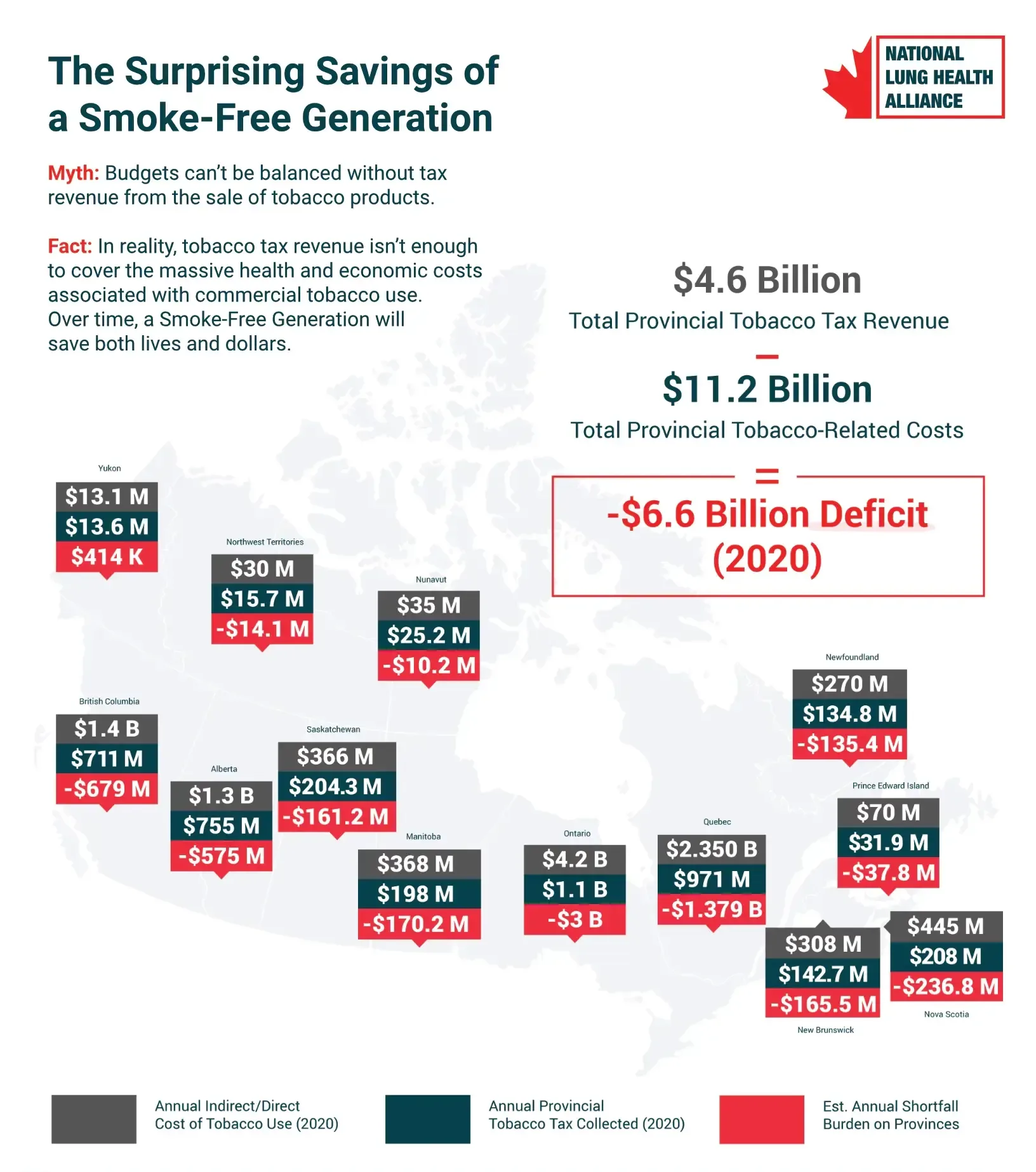
Tobacco use costs Canada an estimated $16.5 billion annually in health-care costs, lost productivity and premature death. Those costs exceed government tobacco tax revenues.
SOURCES
Tobacco tax revenue data:
Physicians for a Smoke-Free Canada. (n.d.). Total tax revenues from tobacco sales in Canada [Fact sheet]. https://www.smoke-free.ca/pdf_1/totaltax.pdf
Tobacco-related harms data:
Canadian Centre on Substance Use and Addiction. (n.d.). Canadian Substance Use Costs and Harms (CSUCH) data visualization tool. Retrieved March, 2025, from https://csuch.ca/tool-v4/explore-the-data/
CANADA WOULDN'T BE ALONE
Canada would join a growing number of countries around the world who are already taking steps to build their own Smoke-Free Generations.
Some governments have introduced Smoke-Free Generation policies, while others have focused on restricting flavours that appeal to youth and children, or strengthening controls on vaping products.
At a Glance: How Countries Are Taking Action
Approach
Country
Current Status
Smoke-Free Generation Policy
Maldives
In force since 2025
Smoke-Free Generation Policy
United Kingdom
Takes effect January 1, 2027
Flavoured Cigarette Restrictions
European Union
Menthol cigarette ban in force since 2020
Vape Flavour Bans In Force
Finland
Only tobacco-flavoured e-liquids are permitted for sale. Fruit, candy, dessert, mint and menthol flavours are prohibited (Since 2016)
Vape Flavour Bans In Force
Netherlands
Only tobacco-flavoured e-liquids are permitted for sale (Since 2024)
Vape Flavour Bans In Force
Latvia
Only tobacco-flavoured e-liquids are permitted for sale (Since 2024)
Vape Flavour Restrictions
Belgium
Under consideration
Vape Flavour Restrictions
France
Under consideration
Vape Flavour Restrictions
Greece
Under consideration
Vape Flavour Restrictions
Portugal
Under consideration
Vape Flavour Restrictions
Spain
Under consideration
Outright Ban on Vapes
Mexico
In force
8 in 10
(80%) Canadians aged 18-29 back a Smoke-Free Generation law
85%
Canadians support restricting youth-appealing vape flavours, including candy, fruit and other sweet flavours
The answer is yes.
Canadians overwhelmingly support actions that help build a Smoke-Free Generation.
FREQUENTLY ASKED QUESTIONS FAQs
Understanding Smoke-Free Generation
What is a Smoke-Free Generation?
The Smoke-Free Generation proposal bans the sale of tobacco and nicotine (vaping) products to anyone born on or after a specific date. It increases the legal age at which people can purchase tobacco and vaping products every year. Over time, it will create a generation of young people who have never been and will never be able to buy commercial tobacco or vaping products, effectively phasing out the sale and use of tobacco and nicotine.
How will the policy work in practice? What happens if someone is born in 2008 vs. 2009?
A Smoke-Free Generation works by creating a cut-off date for future sales of commercial tobacco and nicotine products. Anyone who is already legally eligible to purchase these products would continue to have access.
For example, someone born in 2008 would still be able to purchase nicotine products once they reach the legal age. Someone born in 2009 or later would never become eligible to legally purchase commercial nicotine products, while avoiding any changes for today’s adults.
Does this affect adults?
No. It does not affect current adults or anyone already old enough to buy commercial tobacco and nicotine products. It focuses on keeping future generations from becoming eligible to buy commercial nicotine products.
Does this ban vaping tomorrow?
No. Vaping products, as well as other commercial tobacco products like cigarettes, will continue to be available to those who are legally able to purchase them. The Smoke-Free Generation approach looks to phase these products out slowly by increasing the age of purchase each year.
Is this government overreach or a loss of personal freedom?
A Smoke-Free Generation is designed to protect future generations from nicotine addiction, not to restrict the choices of adults today. Anyone who can legally purchase nicotine products when the policy takes effect would continue to be able to do so.
Like other age-based public health measures, Smoke-Free Generation aims to protect young people while balancing individual choice and public health.
Are current nicotine users required to quit?
No. The Smoke-Free Generation policy would not make current users quit or ban products legally bought by adults. It’s a gradual public health plan focused on the future and prevention.
Products and What's Included
What products are included?
Smoke-Free Generation covers commercial tobacco and vaping products more broadly, including cigarettes, cigars, chewing tobacco, vapes and e-cigarettes, smokeless nicotine products, and future nicotine products that may enter the market.
Will this include cannabis?
No. A Smoke-Free Generation policy is focused on commercial nicotine products, such as cigarettes, vapes, nicotine pouches and other tobacco products.
Cannabis is regulated under a separate framework in Canada and is not part of current Smoke-Free Generation proposals. We will continue to follow emerging research on cannabis and lung health, while supporting evidence-based measures that help prevent substance use among children and youth.
Why This Matters
Why is this needed now? Is youth nicotine use really that common?
While smoking rates have declined over time, youth use of nicotine products such as vapes and nicotine pouches has grown rapidly over the past decade. Many young people are being exposed to highly addictive nicotine products at an early age. A Smoke-Free Generation aims to stop the next generation from addiction before it starts.
Why focus on youth?
Although the amount of Canadians who use commercial tobacco products, like cigarettes, has declined over the last number of years, we have seen the opposite with other nicotine products like vapes or nicotine pouches, especially among youth. We also know that most people who are addicted to nicotine started using products before age 18. A Smoke-Free Generation helps to protect young people from accessing these products and prevents nicotine addiction in youth before it can begin.
Could this help my child avoid smoking and nicotine addiction?
Most people who become addicted to nicotine begin using nicotine products before the age of 18. By preventing future generations from legally purchasing tobacco and vaping products, and making these products increasingly unattainable for young people, a Smoke-Free Generation reduces opportunities for experimentation and addiction before they begin.
Why should parents support a Smoke-Free Generation if their child doesn't smoke or vape?
In some provinces in Canada where vaping is most prevalent, upwards to 1 in 4 youth have vaped in the last month – chances are a young person you care about vapes! Even if your child has never used nicotine products, they still face exposure through peers, social environments, marketing influences, and products designed to appeal to youth.
The goal is to stop nicotine addiction even if products change over time. Vaping products expose users to harmful substances, and companies may make or sell future nicotine products in ways that appeal to young people. Supporting a Smoke-Free Generation helps reduce the availability and normalization of nicotine products for the next generation.
Why focus on tobacco and nicotine rather than other products?
Commercial tobacco is the leading cause of disease and death worldwide. Prioritizing these products, and protecting the next generation from the harms and addiction caused by them, is one of the most effective public health measures that can be implemented to ensure a healthier Canada moving forward. This is especially important given that youth who vape are approximately 3 to 4 times more likely to go on to start smoking cigarettes than youth who have never vaped.
What About Other Approaches?
Why not just educate young people? Isn’t youth education enough?
Education remains important, but education works best when it’s supported by policies that reduce access to addictive products. For example, smoking rates have declined over time because of measures like smoke-free spaces, restricted advertising, and banning flavoured tobacco products. A Smoke-Free Generation combines prevention with public awareness efforts to better protect future generations.
Why not just enforce existing laws?
While existing laws should still be enforced, the amount of youth who are using nicotine products is rising. In some provinces, smoking rates are even starting to climb again. Bold strategies need to be put in place to protect the next generation.
Won't this just create a black market?
Any policy change can have unintended consequences, which is why implementation and enforcement matter. A Smoke-Free Generation takes a gradual, phased approach, giving governments, retailers, and communities time to adapt.
As the affected population grows over time, education, enforcement, and compliance measures can evolve alongside it. Supporters believe this long-term approach helps reduce nicotine addiction while avoiding sudden disruptions.
International Experience / Canada Can Learn from Global Leaders
Has this been done elsewhere?
There has been increasing interest and support for generational bans globally. Since 2025, Maldives has had an active generational ban for smoking for those born in or after 2007. New Zealand, which has some of the lowest smoking and vaping rates in the world, introduced a generational ban that was only hampered by a change in government. The United Kingdom has announced a generational ban to take effect January 1, 2027 for those born in or after 2009. Singapore, France, Thailand, Taiwan, Belgium, Finland, Denmark and Norway are discussing a generational ban. Sweden, the only country to reach Smoke Free Status (<5% adult population smokes daily) supports the use of generational bans in other countries to further nicotine harm reduction.
Indigenous Rights and Traditions
How will Indigenous ceremonial tobacco use be affected?
Ceremonial tobacco, otherwise known as sacred tobacco or traditional tobacco, would be exempt from the ban. Ceremonial tobacco is important to many First Nations communities and plays a role in healing, learning and spirituality.
What about tobacco sales on Indigenous lands?
This is an area where ongoing dialogue and collaboration would be essential. Indigenous rights, jurisdictions, and community-led decision-making are important considerations in any discussion about tobacco policy. Any Smoke-Free Generation approach needs to be developed in partnership with First Nations, Inuit, and Métis communities and respect Indigenous rights, traditions and governance.
Economic and Retail Impacts
What about small retailers who rely on revenue from tobacco and nicotine sales?
We recognize the practical realities faced by businesses and that tobacco sales contribute to the revenue of some retailers. A phased approach would give businesses time to adapt, adjust their product offerings and plan for changing consumer demand.
Taking Action
How does signing the pledge help?
Signing the pledge shows elected officials that Canadians support stronger measures to protect children and youth from nicotine addiction. Public support helps demonstrate that families want action from their leaders and changemakers to create a healthier future for the next generation. Have you joined the movement?
RESOURCE HUB
Looking to learn more?
Whether you’re a parent, educator, health professional, community leader, or simply curious to learn more, these resources can help you navigate conversations with children and young people and stay informed about the latest research, policies, and prevention strategies.
Browse our collection of guides, toolkits, research, podcasts, and educational resources:
Lung Saskatchewan’s “Understanding Youth Vaping” a Let’s Talk Lungs Podcast
BC Lung: “A Canadian Smoke-Free Generation” Policy Paper
A deeper look at the evidence and rationale behind a Smoke-Free Generation approach. Visit BC Lung to view and download.
The Surprising Savings of a Smoke-Free Generation
A visual snapshot showing the economic costs of tobacco use in Canada compared to tobacco tax revenues.
Educator Toolkit
Lung Saskatchewan’s classroom-ready resources and learning materials for Grades 4-6 and 7-9 teachers to support prevention-focused education.
Parent Conversation Guide
Talking with your teen or child about vaping can feel challenging. This BC Lung resource offers tips on how to answer common questions about vaping with clear, age-appropriate, evidence-based responses. Available in 6 languages.
NLHA PARTNERS & COALITION




HOW DO YOU
WANT TO HELP
BUILD A
SMOKE-FREE
GENERATION?
I AM:
Thank You!
You've joined Canadians from across the country who support protecting youth from tobacco, vaping, and nicotine products. Thank you for being part of this coast-to-coast effort.